
A roughly 3-minute scientific video
Introduce the disease, treatment approach and available evidence before a meeting or education session, with a script tailored to your audience.
Make a three-component binding mechanism easier to understand. Follow the explanation from pancreatic tumor context to the molecular interaction, then examine the clinical evidence.
Daraxonrasib (RMC-6236) acts through a three-component complex involving cyclophilin A and active RAS. Showing the partner protein makes its mechanism more intelligible than depicting a small molecule simply attaching to RAS.
The molecular view uses PDB 9BG6, an experimental complex of daraxonrasib, KRAS G12V and cyclophilin A. Its deposited nucleotide is a GTP analogue; the static structure does not show a hydrolysis reaction.
A structure can establish a binding arrangement without measuring a drug’s journey through tissue. This example makes that distinction explicit: experimental molecular coordinates support the structural view; tissue layouts and animated approaches are explanatory.
Daraxonrasib binds cyclophilin A; the pair engages active RAS and blocks effector binding.
Four panels connect pancreatic tumor tissue, active RAS at the cell membrane, the experimental RAS–cyclophilin A–daraxonrasib complex, and a schematic of effector blockade and GTP hydrolysis.

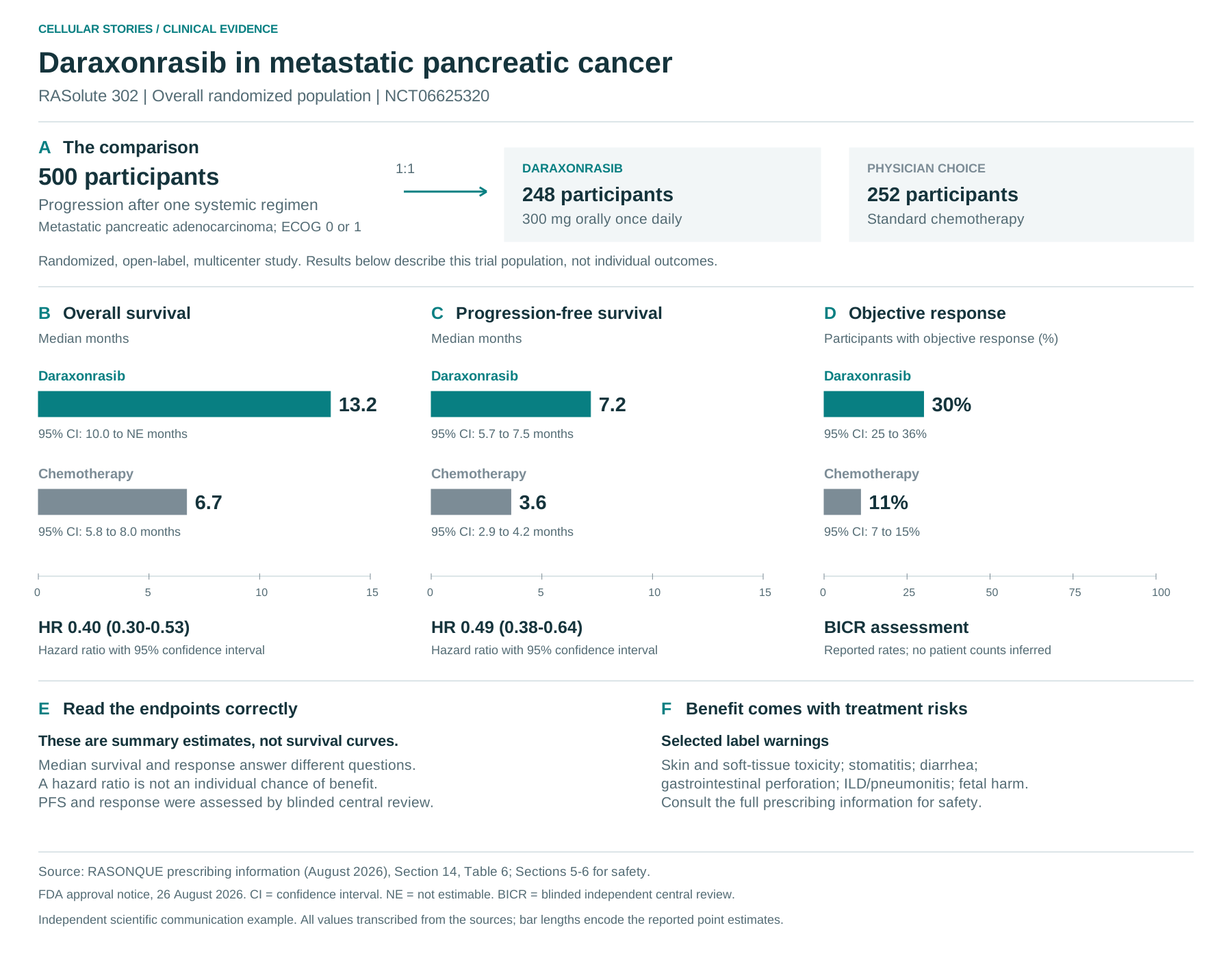
The figure compares daraxonrasib with physician-choice chemotherapy in previously treated metastatic pancreatic cancer, showing overall survival, progression-free survival and objective response, alongside confidence intervals and selected safety warnings.

The evidence brief explains the trial population, endpoints and risks, and distinguishes the overall randomized population from the RAS G12 subgroup.
The mechanism summary below the film is based on the primary sources linked here. The source notes describe how those references relate to the visuals.
The experimental structure supports the final binding arrangement. The approach of the molecules, tumor layout and changes in cell populations are authored for explanation. Clinical outcomes come from the cited clinical evidence, not from running the scene.
A content foundation for physician education on RAS inhibition, or a separately scoped investor and partner communication program. An audience-specific version can introduce the treatment rationale before a meeting and provide a resource for the scientific questions that follow.
Introduce the disease, treatment approach and available evidence before a meeting or education session, with a script tailored to your audience.
Give people a resource to revisit and share after a study discussion, physician presentation or partnering meeting, with mechanism steps and supporting references available.
A focused, referenced review of the mechanism, clinical findings and open questions, including two publication-quality figures. Reuse the figures in presentations, with captions, references and editable SVG, vector PDF and PNG exports.
Tell us about the treatment, audience and milestone. We will scope the program objectives, scientific content, formats, review process and evaluation needs, whether for patient or physician education, or a separate investor and partner communication program.
Discuss your education needs ↗