Patient questions
Explain why the research is being conducted, what is known and what remains uncertain.
Build a study education program that explains the research purpose, treatment approach and practical commitments to patients and caregivers. We create protocol-specific videos, interactive explanations, and a scientific report and literature review with two publication-quality figures, with versions for investigators and site staff scoped around their education needs.
 Watch the CAR-T example ↗
Define what prospective participants need to understand: why the study is being conducted, what is known and uncertain, and what taking part could involve. Build those questions into a reviewed explanation that sites can share consistently, with an optional understanding check or feedback survey.
Explain why the research is being conducted, what is known and what remains uncertain.
Make visits, procedures and practical commitments easier to discuss using the study’s actual requirements.
Give investigators and staff a shared visual explanation to introduce the study and answer common questions.
A typical program combines these outputs with an audience-needs brief, objectives, a sourced script and storyboard, and agreed scientific review. The video is roughly 3 minutes. The report includes a focused literature review of the mechanism, clinical evidence and open questions, with two publication-quality figures. Audience-specific versions and a simple evaluation component are agreed in the scope.
Watch the scientific film ↗01 · Scientific videoIntroduce unmet need, trial purpose, treatment science and available evidence in an audience-appropriate script.
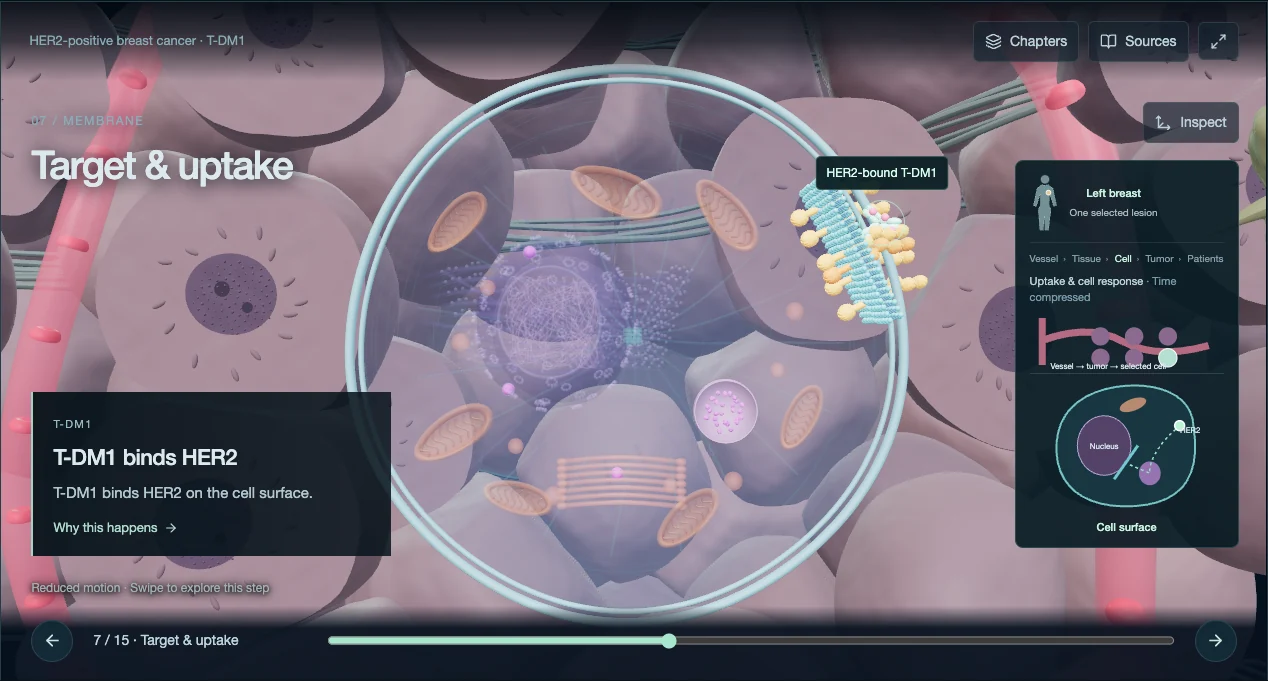 Try the T-DM1 interactive example ↗02 · Interactive website
Adapt the interactive format to explain the treatment and study-specific participation information, with a clear route to the study team.
Receive a focused, referenced scientific report and literature review covering the mechanism, clinical findings and open questions, including two publication-quality figures. Reuse those figures in decks and educational resources, with captions, references and editable SVG, vector PDF and PNG exports. The examples above show the figure format, not a complete report.
Independent educational demonstrations, not commissioned client work or manufacturer endorsements. The CAR-T and T-DM1 examples demonstrate production formats; they are not sponsor-approved participant materials.
We plan the content and review points around the actual protocol. Participant materials require sponsor and relevant ethics review before use and support the study-team conversation without replacing informed consent or determining eligibility. Where results are not available, we agree on a sourced evidence display. Participant recruitment and site distribution are separately scoped responsibilities.
Agree on the questions to answer, evidence, intended use, deadline and program scope.
Develop the sourced script and storyboard with your designated reviewers, then produce the film, website, scientific report and literature review with two figures.
Complete the agreed reviews and audience adaptations. Scope knowledge checks or a feedback survey around the learning objectives.
Accreditation, faculty recruitment and audience distribution are scoped separately with appropriate partners when needed.
Share the study, intended audience and recruitment or site-education milestone. We will scope the objectives, materials, audience adaptations and review process around the protocol.
Discuss your education program ↗James Baker · Founder · james@cellularstories.com

