
A roughly 3-minute scientific video
Introduce the disease, treatment approach and available evidence before a meeting or education session, with a script tailored to your audience.
Help viewers connect HER2 recognition at the cell surface with the drug’s action inside the cell. This example follows delivery, uptake and payload processing, then presents the clinical findings and their study context.
T-DM1 (ado-trastuzumab emtansine) links the HER2-binding antibody trastuzumab to DM1, a microtubule inhibitor. The communication challenge is showing how recognition at the cell surface connects to an effect inside the cell.
This sequence follows section 12.1 of the KADCYLA prescribing information. It highlights payload delivery; the label also describes antibody-mediated effects.
For a physician education program, the useful question is not simply whether the drug binds HER2. It is what must happen after binding for the payload to act. The interactive experience lets a viewer pause at those transitions; the film gives a guided explanation.
Six panels trace the antibody–drug conjugate from HER2 binding through cellular uptake and lysosomal processing to microtubule disruption and cell-cycle arrest.

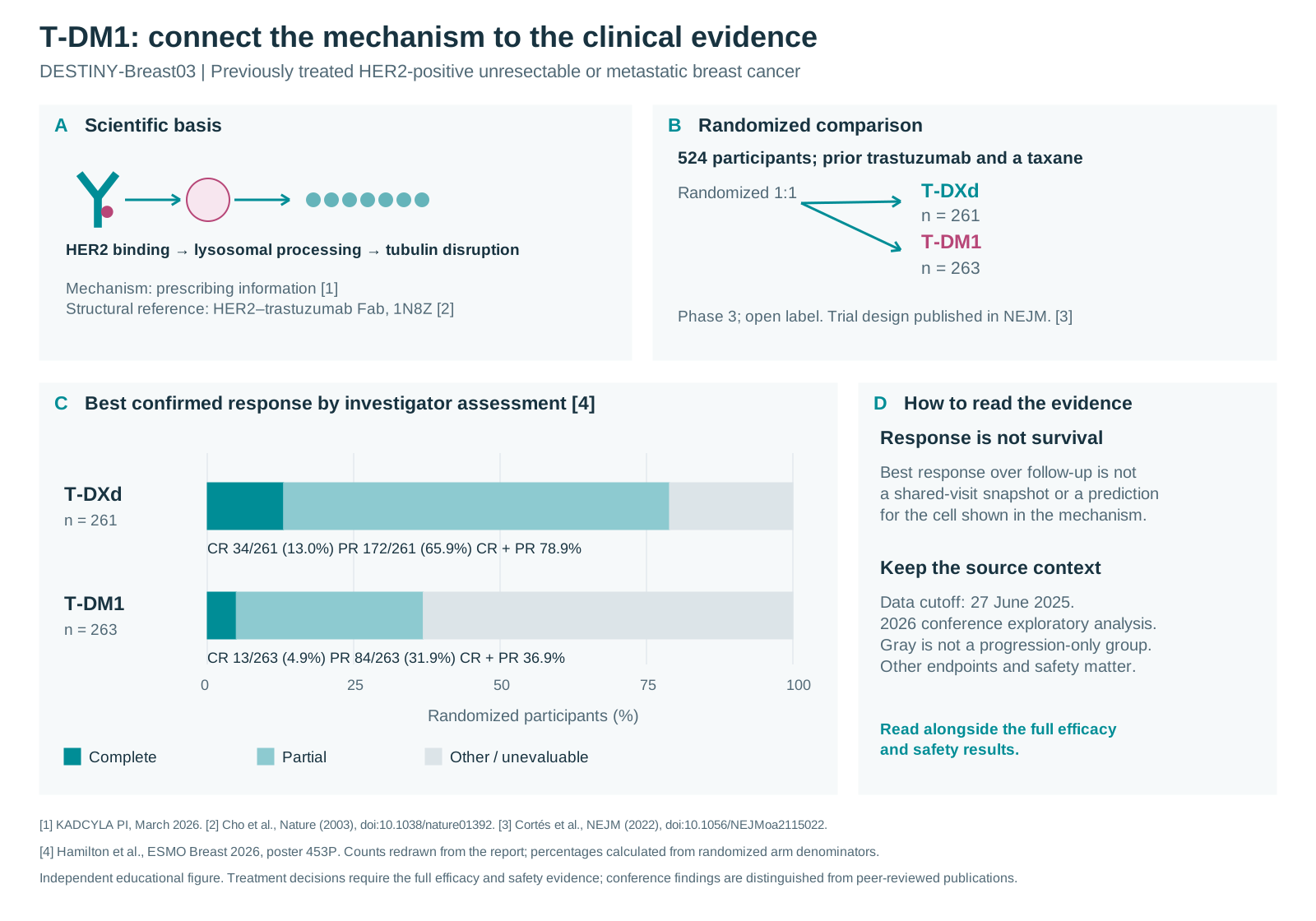
The clinical-results figure compares confirmed complete and partial responses to T-DXd and T-DM1 in DESTINY-Breast03, with the trial design, randomized treatment groups and source notes.

The companion evidence brief also summarizes progression-free and overall survival in EMILIA and DESTINY-Breast03, with selected safety findings and the dates of each analysis.
The mechanism summary below the film is based on the primary sources linked here. The source notes describe how those references relate to the visuals.
The film follows selected delivery and cellular events. Its tissue arrangement and timing do not measure transport efficiency. DESTINY-Breast03 compares trastuzumab deruxtecan with T-DM1; the response figure is not evidence that the animated mechanism predicts an individual outcome.
A content foundation for a physician education program about antibody–drug conjugates, with learning objectives built around delivery, uptake and intracellular action. The film introduces the sequence, the interactive experience supports questions about individual steps, and the figures can carry the explanation into a medical presentation.
Introduce the disease, treatment approach and available evidence before a meeting or education session, with a script tailored to your audience.
Give people a resource to revisit and share after a study discussion, physician presentation or partnering meeting, with mechanism steps and supporting references available.
A focused, referenced review of the mechanism, clinical findings and open questions, including two publication-quality figures. Reuse the figures in presentations, with captions, references and editable SVG, vector PDF and PNG exports.
Tell us about the treatment, audience and milestone. We will scope the program objectives, scientific content, formats, review process and evaluation needs, whether for patient or physician education, or a separate investor and partner communication program.
Discuss your education needs ↗